
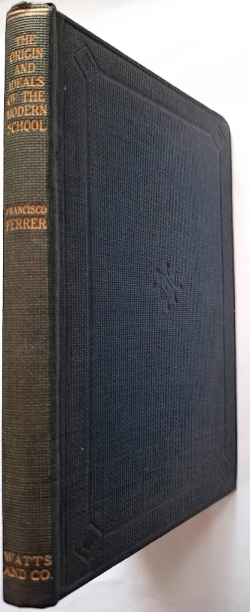
The Origin and Ideals of the Modern School
Type
Book
Authors
DDC
370
Category
Publication Year
1913
Publisher
Watts & Co, United Kingdom
Abstract
Translated from the Spanish by Joseph McCabe
Download from
https://www.gutenberg.org/ebooks/66644
https://archive.org/details/originidealsofmo00ferr/page/n5/mode/2up
Download from
https://www.gutenberg.org/ebooks/66644
https://archive.org/details/originidealsofmo00ferr/page/n5/mode/2up
Description
Ferrer's libertarian pedagogy borrowed from 18th century rationalism, 19th century romanticism, and pedagogues including Rousseau, Pestalozzi, Froebel, Kropotkin, and Tolstoy. This tradition pursued freewheeling liberties for children at the expense of conformity, regulation, and discipline. It combined play and crafts alongside academic work and championed traits of reason, dignity, self-reliance, and scientific observation over that of piety and obedience. It advocated for learning through experience rather than drilled instruction by rote, and for treating children with love and warmth. This model's adherents, in seeking a school that eschewed religious and political authority, thought that changes in mass education would circumvent the stunted public enlightenment and preservation of status quo that they blamed on the influence of both church and state.
Free education, to Ferrer, entailed educators who would use improvised experimentation to arouse the child's will and autodidactic drive rather than impose their own dogmatic ideas through formal curriculum
Free education, to Ferrer, entailed educators who would use improvised experimentation to arouse the child's will and autodidactic drive rather than impose their own dogmatic ideas through formal curriculum
Biblio Notes
In 1901, Ferrer founded the Barcelona Modern School, Escuela Moderna, which sought to provide a secular, libertarian curriculum as an alternative to the religious dogma and compulsory lessons common within Spanish schools. Ferrer's pedagogy borrowed from a tradition of 18th century rationalism and 19th century romanticism. He held that children should wield freewheeling liberties at the expense of conformity, regulation, and discipline. His school eschewed punishments, rewards, and exams, and encouraged practical experience over academic study. The school hosted lectures for adults, a school for teacher training, and a radical printing press, which printed textbooks and the school's journal. Around 120 offshoots of the school spread throughout Spain. The rapidity of Ferrer's rise troubled Spanish church and state authorities, who viewed the school as a front for insurrectionary activity.
Ferrer was held in association with the 1906 assassination attempt on the Spanish King, which was used as a pretext for closing the school, but was ultimately released without conviction under international pressure a year later. Ferrer traveled Europe as an advocate of the Spanish revolutionary cause, founded a libertarian education advocacy organization, and reopened his press.
In mid-1909, Ferrer was arrested and accused of orchestrating a week of insurrection known as Barcelona's Tragic Week. Though Ferrer's involvement was likely not as blameless as intimated by his peers, he did not mastermind the events as charged. The ensuing court case, remembered as a show trial by a kangaroo court, resulted in Ferrer's execution and triggered international outcry, as Ferrer was widely believed to be innocent at the time of his death. He was prominently memorialized in writing, monuments, and demonstrations across three continents. The protest became a movement to propagate his educational ideas, and Modern Schools in his name sprouted across the United States and Europe, reaching into Brazil and Asia.
Ferrer was held in association with the 1906 assassination attempt on the Spanish King, which was used as a pretext for closing the school, but was ultimately released without conviction under international pressure a year later. Ferrer traveled Europe as an advocate of the Spanish revolutionary cause, founded a libertarian education advocacy organization, and reopened his press.
In mid-1909, Ferrer was arrested and accused of orchestrating a week of insurrection known as Barcelona's Tragic Week. Though Ferrer's involvement was likely not as blameless as intimated by his peers, he did not mastermind the events as charged. The ensuing court case, remembered as a show trial by a kangaroo court, resulted in Ferrer's execution and triggered international outcry, as Ferrer was widely believed to be innocent at the time of his death. He was prominently memorialized in writing, monuments, and demonstrations across three continents. The protest became a movement to propagate his educational ideas, and Modern Schools in his name sprouted across the United States and Europe, reaching into Brazil and Asia.
Number of Copies
1